Monday, January 10, 2011

Persuasive Letters


Hello Readers!  The above banana was in the mailbox of North Street School's principal, Mr. Fereira on one of the days I was there to work with him and his amazing teachers.  This young writer received messages from his own mom on bananas in his lunch and perhaps decided to persuade Mr. Fereira to eat more bananas.  Interesting paper choice Little Love!

Are you in the midst of a persuasive writing unit in your first, second, or third grade classroom?  You might be looking for some supports.  I have a bunch of links to share with you that you can use in your classroom right away.

Each link comes from work with teachers like Andi, Sarah, Liz, Katherine, and more that were featured in my book, Teaching Persuasive Writing, K-2.  Special thanks to all of these teachers!

And, special thanks to all of you for honoring your students' voices and giving them an opportunity to make their family, neighborhood, school, and community stronger through their words.

Supports You Can Use in Your Room
Demo Writing from Students
Many teachers like to show students a sample letter at the beginning of a unit to show them how they can make a difference.  You may like the see Alexandra's letter, the principal's response to Alexandra's letter, and Niamh's letter.  You can print each one out, and use them in minilessons and conferences to show kids what is possible in their own letters.

Your Own Demo Writing
You will want to do your own writing in front of students too.  Here is a sample.  Note the ways this teachers has highlighted for students the things she is doing as a writer to make her letter more persuasive.


A Newly Organized Writing Center
You may also want to create mail baskets to organize all of those letters!  See the photo from Andi's writing center to see how she organized for delivery.  You can also see how she organized extra supplies.

Here is another photo of Andi's writing center, labeled as the Post Office for this Unit.

Charts to Support Independence
Andi and I also used this chart in many minilessons to help kids craft powerful letters with supporting detail.  It seems to match the common core standards for developing an opinion and then supporting that opinion with reasons.

Saturday, January 8, 2011

Book of the Month Suggestions

Are you looking for some new read alouds for your classroom?  Perhaps you are searching for titles that you can give to all the teachers in your school as a school-wide book of the month project.  I am an avid collector of children's picture books and happy to tell you about some of my favorite titles.  I chose the following books because they do the following things:
Provide opportunities for whole class conversations on issues that matter to students.

Provide opportunities for conversation with young students as well as upper elementary students.

Provide opportunities to learn new vocabulary and read in a variety of genres.

Provide opportunities for community building and opportunities to build a positive school culture.

If you want to read more about school-wide read alouds, I recommend chapter three in A School Leader's Guide to Excellence by Carmen Farina and Laura Kotch.

On with the titles!  Click on them to see links to purchase and to read a few reviews.  My apologies in advance if this post makes your pocketbook a little lighter.  They are all so good!

Calvin Can't Fly: The Story of a Bookworm Birdie

Naked Mole Rat Gets DressedNaked Mole Rat Gets DressedHow to Heal a Broken Wing
How to Heal a Broken WingAnimals Nobody Loves (Nonfiction)

Animals Nobody Loves

Pemba Sherpa

City Dog, Country Frog

Once I Ate a Pie

Looking Like Me

Finally, if you love books as much as I do, you MUST get a membership to the Cooperative Children's Book Center.  This non-lending children's book library is on the campus of the University of Wisconsin Madison.  The librarians on staff (who have historically been members and/or chairs of the Caldecott and Newberry Award panels) read and read and read along with members like you and me to develop reading lists that teachers, parents, and librarians can use.  Here is a link to their site that shares some of the elementary book lists.  If you use the site, please consider joining me as a member.

Book Room Update

New photos have been added to the Book Room post!  Go there to see some shots of the book room at OWNCS in Astoria, Queens.

And... if you are looking for some titles to refresh your baskets, I have some favorites.  The following is a short list of some titles for character studies and book clubs that I have been sharing lately:

Make Way for Dyamonde Daniel is a great heroine for second and third grade chapter book readers.  This is the first book in a great series by Nikki Grimes.
Make Way for Dyamonde Daniel

Welcome to the Bed and Biscuit is a lovely story of animal friendship involving a cast of characters that warm the hearts of young readers and provide some comic relief as well.  This is the first chapter book in a series of adventures that emergent chapter book readers will enjoy.
Welcome to the Bed and Biscuit

The Magician's Elephant is a beautiful story of magic and hope for 3rd - 5th grade students.  It would make a great book club selection or read aloud to prepare students to have strong book talks.

The Magician's Elephant

Thursday, December 16, 2010

Realistic Fiction Charts to Support Student Independence

Are you in the midst of your realistic fiction writing unit?  Are you looking for ways to support students to work independently on strategies you have taught in minilessons?  You may want to make some charts with your students to do the following:

1.  Track your teaching points - the big ideas of your teaching points - in language the kids can remember and read.
2.  Give clear examples of the teaching points.
3.  Provide language or prompts to help them get started with parter talk or the next step of the writing process.

Of course, there are many possible charts you could make in this unit.  Here are a few I have used with kids in first and second grade classrooms in Manhattan that support independent work based on the three things I mentioned above.

Below:  An example of a chart that tracks some of the big teaching points.

Below:  The next two charts give students some of the language they can use 
while working with their writing partners to work on their fiction stories.


The chart below shows students ways they can "show and not tell" in realistic fiction stories.  These are the same strategies many students used in narrative writing.  Under each strategy are two post-it notes.  The small one is an example of the "tell," what I could say in my story.  Next to it is the more elaborate, "show" post-it, showing what it would look like to get that message across to my reader when I use that elaboration strategy.

 Below:  Close ups of the demo writing on the post-its from the chart above.  The character I have been using in my demonstration writing is Essie, a young girl who loves football and has just moved to her new neighborhood.  She is searching for new friends and her mom wants her to try some new activities.  In one of my stories she refuses to go to dance class.  The examples on the chart are from that story.

Post-it Folders for Readers at Levels A-I

Are you wondering how to support your students to talk about books with partners?  You might notice that your students are good at sharing the reading time during partner time, but talking about the books seems more difficult.  Perhaps your students are language learners or perhaps they are unsure how to talk about books with friends.  Maybe the kids don't know how much FUN talking about books can be!  This tool might just be the thing to support your teaching and the kids' talk.  It is a simple post-it note holder!

You can try using this post-it note holder tool with your readers at levels A-I.  Read on for tips on how to teach your young readers how to use this tool to have good conversation.


Model for students the different ways readers can talk about books in Read Aloud time.  Show them how you can mark pages where you and the students were surprised, scared for the characters, full of ideas about the text, etc.  You can create icons with the kids to represent these different ways of thinking just as Kathy Collins teaches us in Growing Readers.  Then put these icons on post-it notes and model placing these in the book as you read, think, and talk with the students.

You'll also want to talk about reading books with other people in your own life.  Talk about your book club meetings you attend and how you and your own reading buddies mark pages to talk about with one another.  Tell the kids how embarrassed you would be if you went to the club with no post-its!  My own book club life give me lots of stories to tell in my minilessons!

Invite the students to make their own post-it note folders or holders.  First grade teachers and I in Queens use simple file folders, post-its, and markers with the students.  The kids the keep this folder in their book baggie or book box so the post-its are reusable and do not get lost, smashed, ripped, etc.

Each day, as students read during independent reading time, coach them to have their post-it folder nearby so they can mark pages in their books to talk about with their partners during partner time.

You may also want to put the talk prompt near the post-it in the folder so when they have partner time, they can remember how to start their conversation.  We placed the matching icon on the folder so kids can match up their post-it in their book with the prompt in the folder.

At the end of each reading workshop (after partner time is over), kids can take the post-its off the pages they marked and place them back into their post-it folders for the next day.

Sunday, November 7, 2010

Partnerships and Post-its: Make Comprehension Visible (Part 2)

The post, Partnerships and Post-its: Make Comprehension Visible Part 1, gave you some ideas to get your partner time back on track.  This post will help you invent some new ways for kids to get ready for their partner time.

In a nutshell, I have been asking kids, reading at level J and above, during reading conferences one or more of following questions:

  • What ideas are you getting in your book right now?
  • What do you think the author want to make you think or believe right now?
  • How are you planning to keep track of your thinking in this book?
  • What are you planning to share with your partner?
Please note, you can ask these questions of readers at lower levels but there may be other strategies you are concerned about as well.

The young readers and I have been inventing some really fun and exciting ways to keep track of their thinking, gather new ideas, and get ready for partner time.  Here are some of the ways the kids can share.  Please keep in mind this is NOT the only way to collect post-its to prepare for partner time.  These are the ways kids invented after rereading their initial post-its and thinking about their books.


Let me show you some of these ideas up-close.
Collect post-its about characters and get ideas about the characters.  First, invite kids to read a few books with the same character.  After they finish reading a book or two, reread the post-its they have so far and ask, "What's the same about these jots?"  Then, get an idea.  Finally, read some more books with the same character with that idea in mind.  See the example of this process below from Henry and Mudge.


Above:  Post-its collected and then students reread them.

Below:  Students developed this idea after asking themselves, "What's the same about these jots?"  
Now they are ready to read on and look for places in other texts to support this idea.  
Or, perhaps they will grow the idea or get a new one.


Collect post-it about the character's journey.  Many realistic fiction stories or narrative nonfiction books are journeys.  One way you can post-it is to read the blurb on the back of the book and/or the jacket cover to learn what the journey will be.  Then, you can collect post-its to follow the journey.  These post-its look like retelling post-its but they can help young readers accumulate text and talk about the main idea, the journey.  They also support thinking about compare and contrast because usually the character does some changing by the end of the journey.
Above:  Post-its to talk about the beginning of Amber Brown's journey.


Last week a second grade told me that The Magic Tree House books were so great and she loved their predictable structure.  She decided to turn to a clean page in her reading notebook and make a four column chart (across 2 pages of the notebook like the journey page above).  She said, "Magic Tree House books always have the characters going somewhere.  Then they have to get away or hide from an evil character, then they have to get something to bring back, and finally they have to escape."  She proceeded to label her column with those 4 headings, "Going, Hiding, Getting, and Escaping."  She decided she would begin by collecting post-its for each part to help her talk about the books with her partners.  I hope I'll have a photo here for you soon!  

The reason why I share this story, is because I want you to know that the ways I have shared above are not the only ways kids can collect jots.  They can and should invent their own ways with you - especially ways that will help them do what readers at this level do:
Monitor for meaning in these longer texts.
Accumulate text while thinking about the main idea.
Make inferences about the characters and begin to develop ideas and then theories.
Consider author's intent and think about the big message of the text.

Happy reading and talking with your students!


Partnerships and Post-its: Make Comprehension Visible in Second Grade (Part 1)

Are you wondering about how to make your reading workshop partner time better?

One thing you can do is wrap some structure around the time.  Remind the kids of all they know how to do during partner time already.  Brainstorm a list of things they learned last year.  Here are two charts that teachers made with their students.  I love some of the ideas they invented together!


This chart uses what kids already know and then reminds them to use their private time to get ready for their partner time.


Take Kathy Collins's advise in Reading for Real and stop your students a few minutes before the private time ends.  Say something like, "Readers, we have two minutes before partner time.  Get ready for partner time.  Mark the pages you want to share, maybe even reread a little on that page so you'll have ideas to share."

Now...  this leads us to big question #2...
Are you wondering how to help your kids collect some jottings about their thinking in reading workshop on those post-its?

Many teachers and I have been thinking about this too, especially as we have kids reading in books and Level J and above.  It seems like the work they need to do as readers is the following:

  • Monitor for meaning in these longer texts.
  • Accumulate text while thinking about the main idea.
  • Make inferences about the characters and begin to develop ideas and then theories.

As teachers and I look at the post-its kids are collecting, we currently see some post-its that look like...

A Retelling
Sometimes these post-its are about favorite parts, funny parts, or scary parts.

A Prediction


Some teachers use a chart that looks like the one above to remind kids of the way predictions sound.


A Statement about a character or a fact from an information book.  


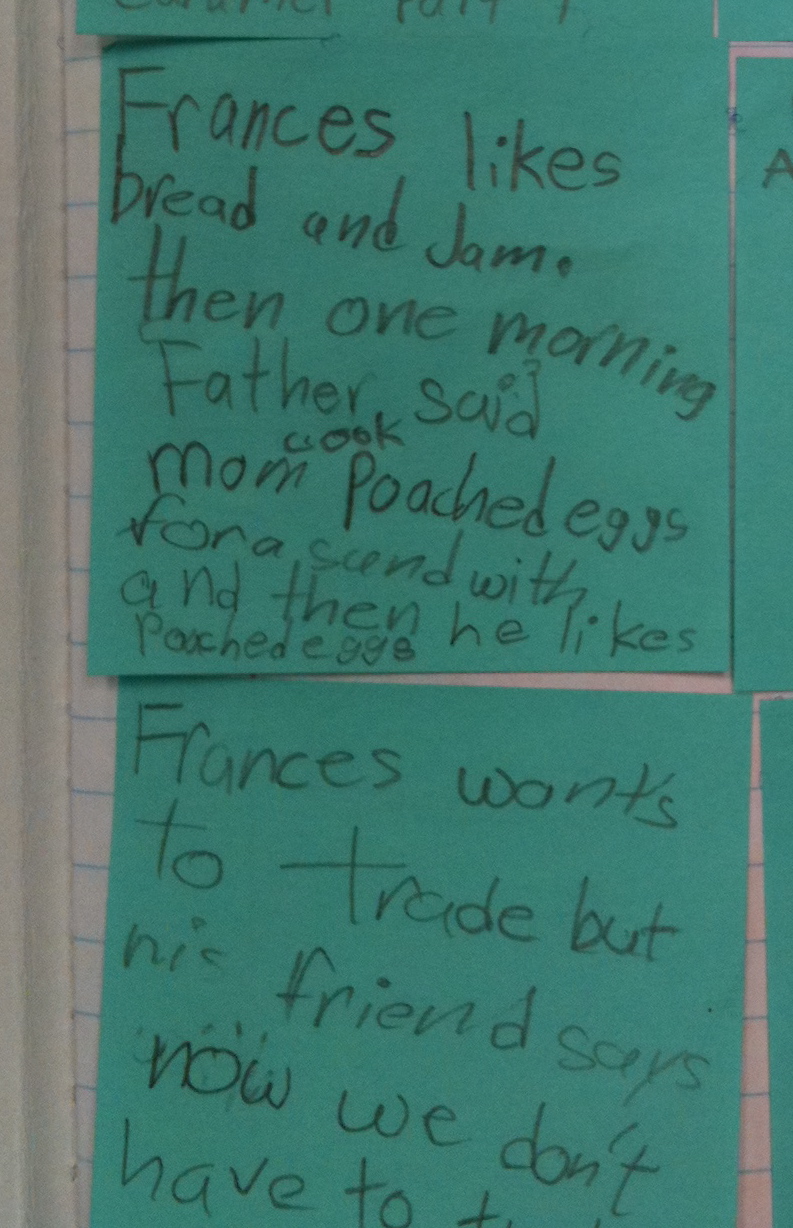
Sometimes these statements sound like ideas.  I made the following mentor post-its with some students during a read aloud of the Houndsley and Catina series by James Howe.  We retold and THEN pushed ourselves to have an idea about the character.  We said, "This makes me think..." and then we jotted.  Click on this photo to see a larger view.

One of the post-its close up:

We found more students collecting post-its with retellings AND ideas after this modeling.  We also carried these post-its around the room with us during conferring time so we could remind students what this kind of thinking looks like.

This is just the beginning.  Remember, the main points of collecting your thoughts on post-its its it to do two things:
1.  To have some evidence of the thinking work you are doing during your independent reading time.
2.  To have some jottings to use to support a conversation when you get together with your partner during partner time.

If you students don't have any way to record their thoughts as they read, you'll want to share with them some of the ways that readers do this.  You can use read aloud as a time to model this as well as your reading minilessons.  You might even have a chart that reminds kids of the different ways they can collect jottings as they read.  See the next post on post-its and partners to help you imagine this!